
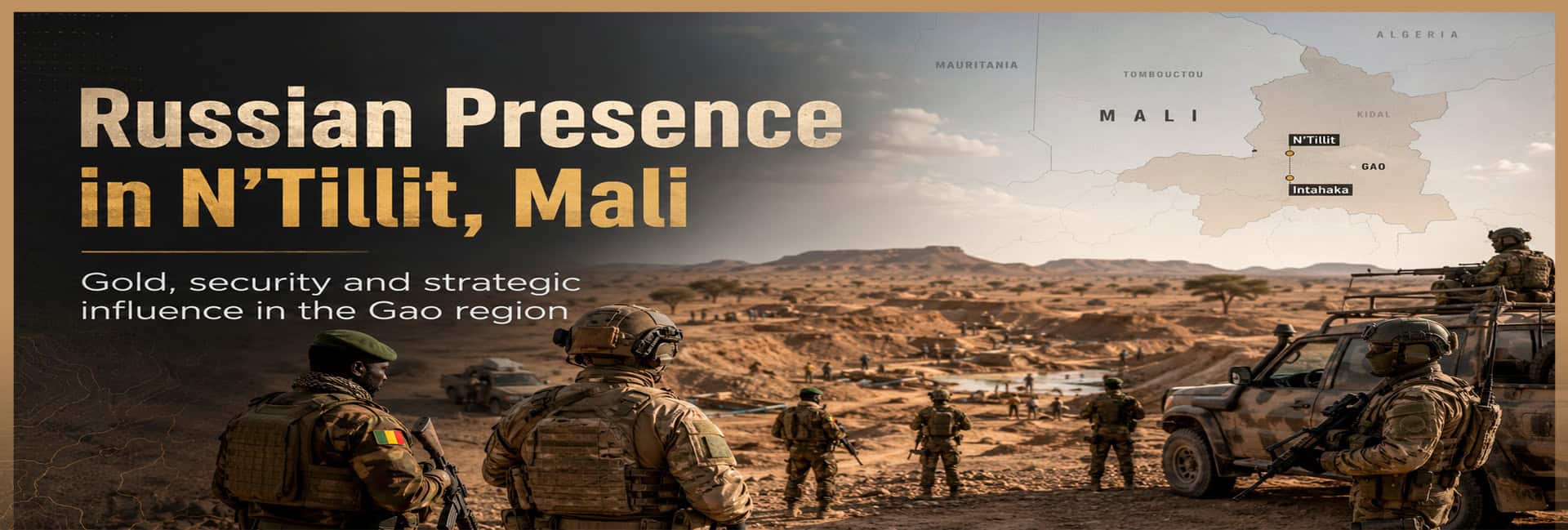
Russian Presence in N’Tillit, Mali
Analysis
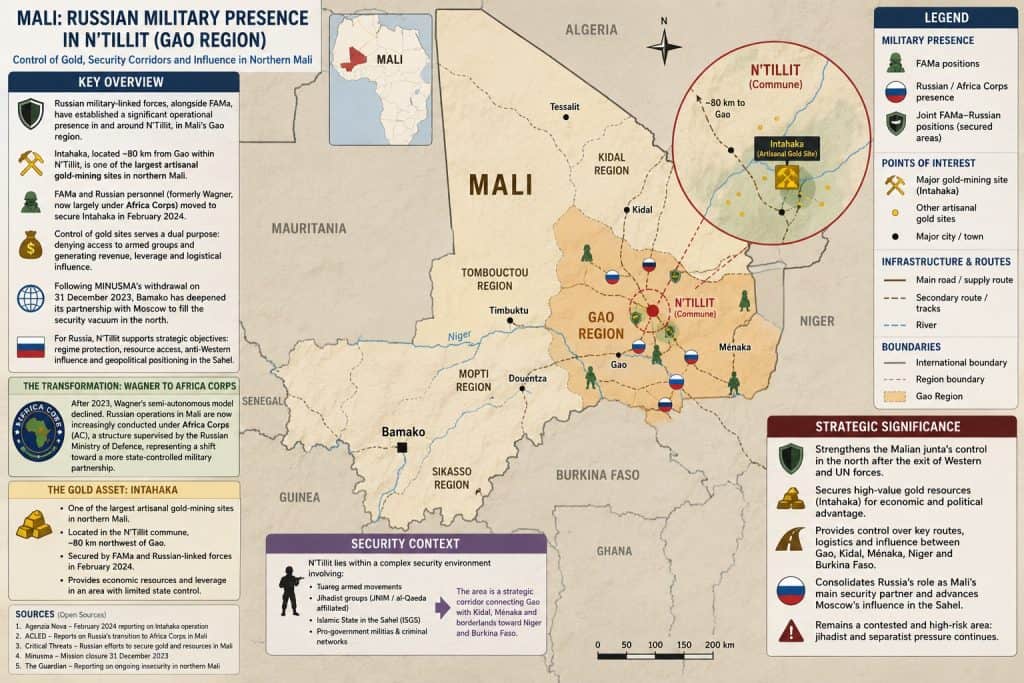
Russian military-linked forces have established a significant operational presence in and around the commune of N’Tillit, in Mali’s Gao region, an area of growing strategic relevance due to its proximity to key artisanal gold-mining zones and contested security corridors in northern Mali. The most important point of interest in this area is Intahaka, widely described in open sources as one of the largest artisanal gold-mining sites in northern Mali and located within the wider N’Tillit area, approximately 80 kilometres from Gao. Reports indicate that the Malian Armed Forces — FAMa —, operating alongside Russian personnel formerly associated with the Wagner Group and now increasingly reorganised under Africa Corps structures, moved to secure the Intahaka mining site in February 2024. ([Agenzia Nova][1])
The Russian role in N’Tillit must be understood within the broader transformation of Moscow’s security architecture in Africa. Following the decline of Wagner’s semi-autonomous model after 2023, Russian military activity in Mali has increasingly shifted toward Africa Corps, a more formal structure supervised by the Russian Ministry of Defence and designed to preserve Moscow’s influence while reducing the operational ambiguity associated with Wagner. ACLED and other conflict-monitoring sources describe this transition as a move from semi-private paramilitary operations toward a more state-controlled Russian military partnership with the Malian junta. ([ACLED][2])
The seizure and securing of Intahaka reflects a dual military and economic logic. On the one hand, the operation allows FAMa and Russian-linked forces to deny access to armed groups, separatist factions and jihadist networks operating across northern Mali. On the other hand, control over artisanal gold production offers a potential source of revenue, local leverage and logistical influence in a region where formal state control remains limited. Several open-source assessments have linked Russian-backed operations in Mali to efforts to secure gold-producing areas and strengthen Moscow’s economic position in the Sahel. ([criticalthreats.org][3])
N’Tillit’s importance is also geographic. The commune lies within the wider Gao security environment, a zone affected by overlapping conflicts involving Tuareg armed movements, pro-government militias, criminal networks and jihadist organisations affiliated with both al-Qaeda and the Islamic State in the Sahel. This makes the area not only a mining asset but also a tactical space for controlling movement, supply routes and influence between Gao, Kidal, Ménaka and the borderlands connecting Mali with Niger and Burkina Faso.
From Bamako’s perspective, the deployment of FAMa and Russian-linked forces around N’Tillit forms part of a wider campaign to restore state authority in northern Mali after the withdrawal of Western and UN security actors. MINUSMA formally ended its mission in Mali on 31 December 2023, after the Malian transitional authorities requested its withdrawal earlier that year. This created a security vacuum that the Malian junta has sought to fill through a deeper partnership with Moscow.
For Russia, the presence in N’Tillit and the Gao region serves several strategic objectives. It allows Moscow to consolidate its role as Bamako’s principal external security partner, reinforce its anti-Western narrative in the Sahel, gain access to resource-rich areas and project influence across a region where French, European and UN influence has sharply declined. The Russian footprint in Mali is therefore not limited to tactical counterinsurgency support; it combines military assistance, regime protection, resource security and geopolitical positioning.
The situation remains highly unstable. Although Russian-backed operations have increased the pressure on some local armed groups, they have not eliminated the insurgent threat. Northern Mali continues to be fragmented, and recent reporting indicates that Russian and Malian forces remain exposed to coordinated pressure from jihadist and separatist actors, particularly in the wider northern theatre. ([The Guardian][5]) As a result, N’Tillit should be assessed as both a strategic asset and a contested operational zone, where control over gold resources, local alliances and military access routes will remain central to the balance of power in northern Mali.
In summary, the Russian presence in N’Tillit is significant because it demonstrates the convergence of three strategic priorities: support for the Malian military junta, control of high-value mineral resources and the consolidation