
The Jihadist War of Attrition in the Sahel
Conflict Analysis
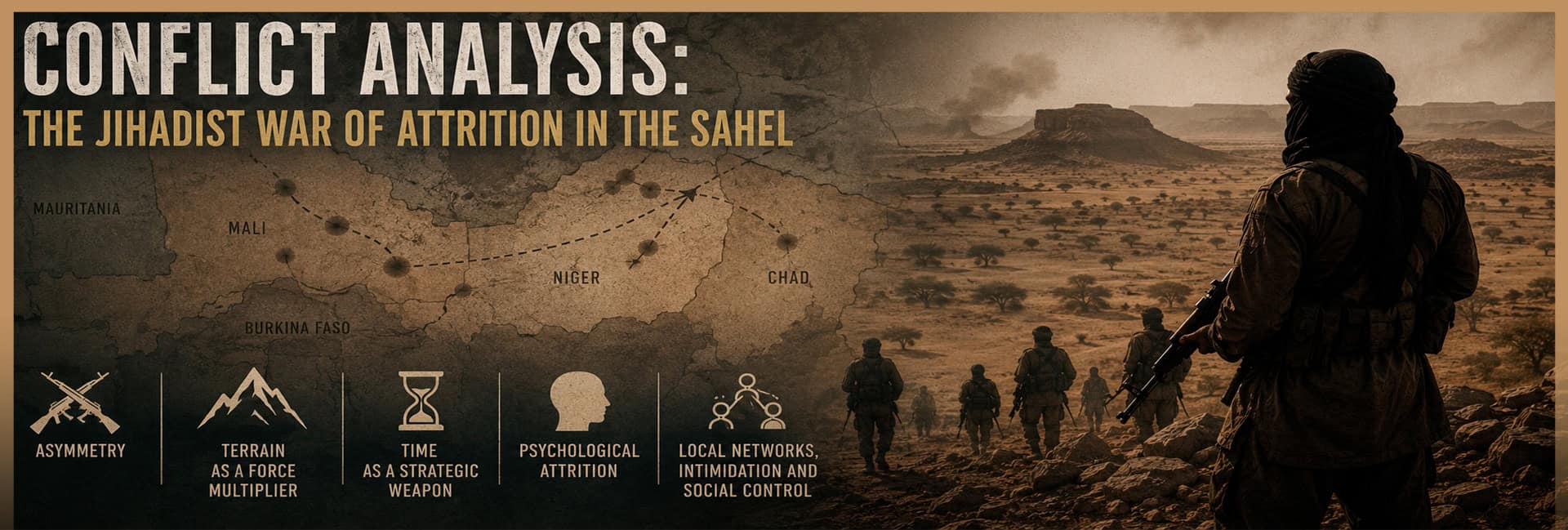
We cannot understand the war waged by jihadist groups in the Sahel unless we analyse the conflict through their operational, strategic and territorial logic. This does not mean justifying their actions, ideology or methods. It means understanding the factors that allow them to sustain a prolonged confrontation against state and international actors that, in conventional terms, possess greater technological, military and logistical capabilities.
The conflict in the Sahel cannot be interpreted merely as a struggle between regular forces and irregular armed groups. It is a war of attrition, adaptation, partial territorial control, psychological pressure and exploitation of the structural weaknesses of states. In this environment, Western or state technological superiority is an important advantage, but it does not, by itself, guarantee strategic victory.
1. The Logic of Asymmetry
Jihadist groups operate from a position of conventional inferiority. In most cases, they do not possess air power, heavy armoured vehicles, advanced surveillance systems, formal logistical chains or consolidated state structures. However, they have demonstrated the ability to resist, expand, withdraw and reappear across different areas of the territory.
Their strategy is based on avoiding direct confrontation when conditions are unfavourable and exploiting the areas where they can hold an advantage: knowledge of the terrain, light mobility, partial integration into local networks, intimidation of communities, the use of time as a strategic tool and adaptability in the face of superior military operations.
In an asymmetric war, victory does not always belong to the actor with the greatest resources. Often, the actor that endures is the one that succeeds in making the political, psychological, economic and human cost of the conflict unacceptable for its opponent.
2. Terrain as a Force Multiplier
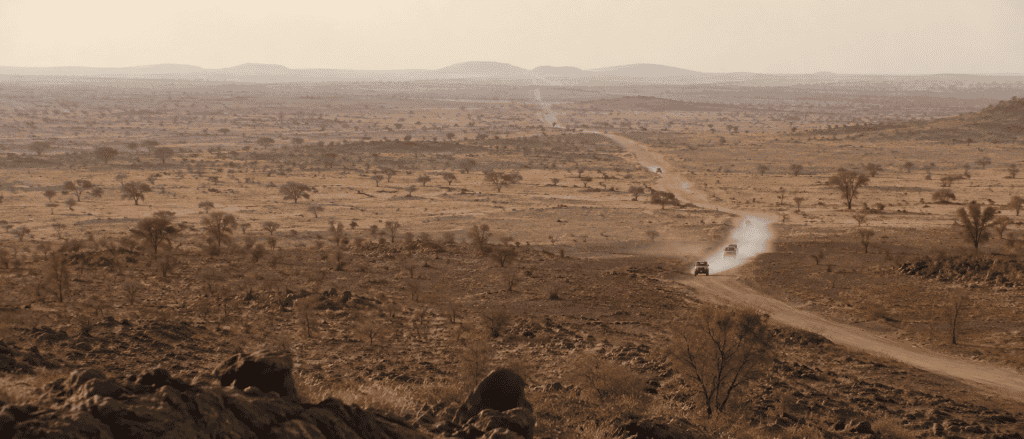
The desert and semi-arid areas of the Sahel are not merely a geographical setting. They are a decisive operational factor. For a conventional force, operating in these spaces requires suitable vehicles, fuel, water, maintenance, medical evacuation, communications, forward bases, updated intelligence and a permanent logistical chain.
For local or regional armed groups, that same environment can become an advantage. They know secondary routes, crossing points, water sources, areas of concealment, tribal dynamics, smuggling networks and zones where state presence is weak or non-existent.
The ability to survive in the desert does not depend only on physical endurance. It depends on the relationship with the environment. A force that needs heavy logistics to remain in the field starts from a structural limitation. A force that can move with light means, local support, informal routes and a low operational profile possess a relative advantage, even without technological superiority.
3. Time as a Strategic Weapon
These groups do not need to achieve a quick victory in the Sahel. Their priority is often to maintain pressure, prevent the normalization of the territory, weaken confidence in the state and demonstrate that no force can guarantee permanent security.
In this model, time becomes a weapon. Each year of prolonged conflict erodes institutions, exhausts budgets, wears down deployed forces, fragments political alliances and reduces the patience of national and international public opinion.
Insurgent logic does not require winning every battle. It is enough to survive, retain the ability to attack, maintain networks of support or coercion, and appear where the adversary cannot sustain a continuous presence. In this context, persistence itself may be perceived by the population as a form of power.
4. Psychological Attrition
The psychological component is central to the Sahelian conflict. Ambushes, attacks against isolated posts, kidnappings, roadblocks and pressure on rural communities produce effects that go beyond immediate tactical damage.
These attacks generate a perception of insecurity, fear, distrust towards the authorities, a sense of abandonment and doubts about the real capacity of the state to protect the population. In many cases, the objective is not to destroy the adversary militarily, but to demonstrate that the adversary cannot provide constant protection.
Attrition also affects foreign forces and their societies of origin. Casualties, the lack of visible results, the complexity of the conflict and the absence of a clear victory fuel political fatigue. Afghanistan demonstrated that overwhelming military superiority may not translate into sustainable political victory if the adversary retains will, sanctuary, narrative and capacity for reconstitution.
5. Local Networks, Intimidation and Social Control
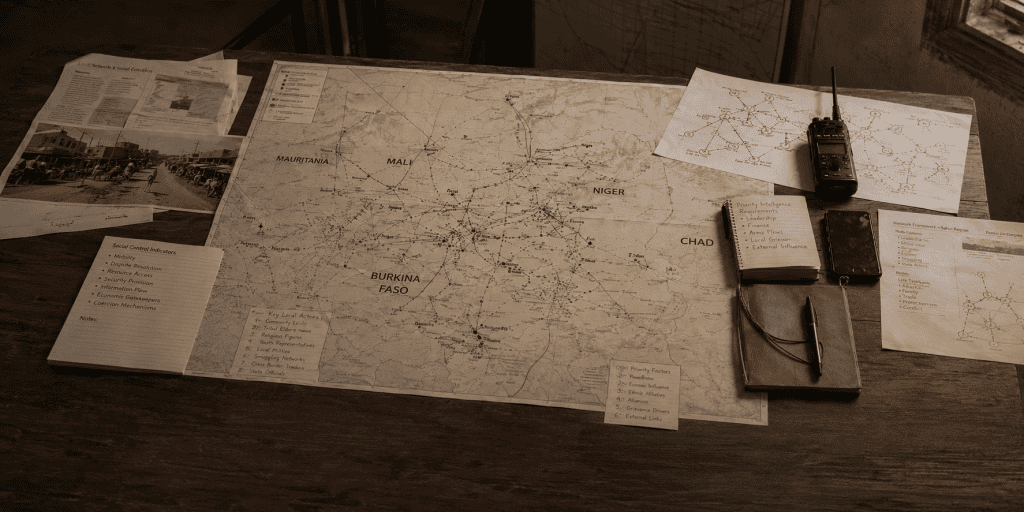
The strength of these groups does not reside only in their fighters. It also depends on their networks. Informants, coerced collaborators, tribal links, smuggling routes, ideological sympathisers, opportunistic actors and communities subjected through fear all form part of the ecosystem that enables their survival.
Social control can be exercised in many ways: coercion, punishment, local arbitration, religious imposition, protection against rivals, exploitation of grievances, access to resources or the simple absence of state alternatives. In areas where the state does not provide security, justice or basic services, armed groups can present themselves as a de facto authority, even if this authority is imposed through violence and intimidation.
This social dimension explains why a purely military response is insufficient. The elimination of fighters does not necessarily destroy the conditions that allow them to be replaced.
6. The Vulnerability of Conventional Forces
Regular forces are more powerful, but they are also more visible, more dependent and more predictable. They need bases, convoys, fuel, maintenance, authorisations, communications, intelligence, medical support and political coordination.
That structure, necessary for operating safely and legally, also creates vulnerabilities. Convoys can be ambushed. Bases can be monitored. Routes can be mined. Local suppliers can be infiltrated. The population can be intimidated into refusing cooperation. Rotation cycles can cause accumulated knowledge of the terrain to be lost.
Irregular armed actors exploit precisely these rigidities. They do not seek to control every kilometre of territory. Instead, they seek to condition the adversary’s freedom of movement and force it to operate at increasing cost.
7. Technological Superiority: An Advantage, Not a Solution
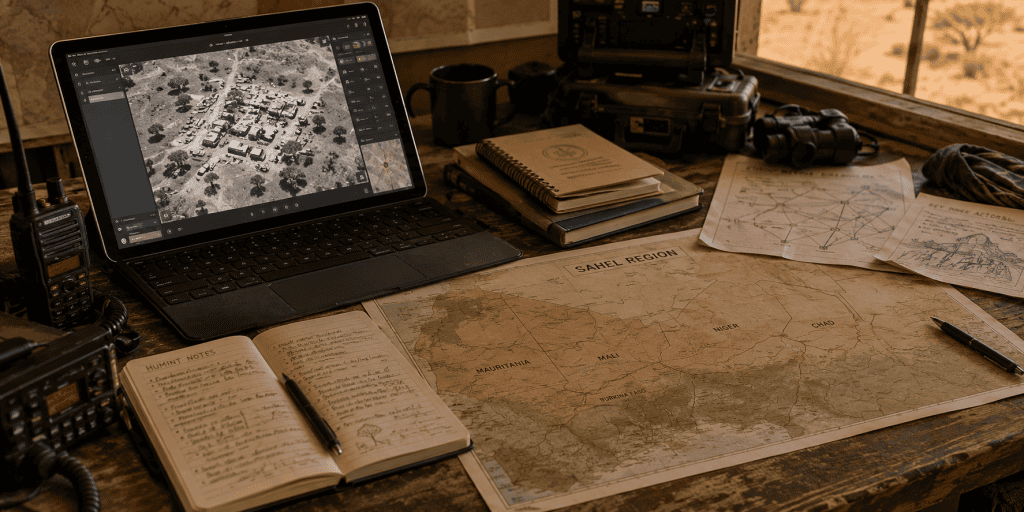
Technology is indispensable. Drones, satellites, interceptions, sensors, air assets, electronic surveillance and data analysis provide a real advantage. They make it possible to detect patterns, identify targets, protect forces, monitor routes and anticipate threats.
But technology does not replace human intelligence or political understanding of the environment. A drone can observe movement, but it does not always interpret loyalties, fears, rivalries, local agreements or changes in a community’s perception. A surveillance system can detect a threat, but it cannot resolve the causes that allow that threat to regenerate.
The strategic error appears when technical superiority is confused with effective control. Seeing more does not always mean understanding better. Striking with precision does not always mean stabilizing.
8. The Precedent of Afghanistan
Afghanistan offers a relevant lesson for the Sahel. For years, international forces with enormous technological, air, logistical and economic superiority fought against an adversary that was poorer, less equipped and apparently inferior. However, tactical victory was not transformed into lasting strategic victory.
The problem was not only military. It was political, social, territorial and temporal. The adversary understood that it could survive, wait, wear down its opponents and capitalise on their mistakes. The international coalition had political clocks; the insurgency had strategic patience.
In the Sahel, although the context is different, there is a clear parallel: when the adversary does not need to defeat a superior force conventionally, but only prevent it from converting its superiority into stability, the conflict becomes a test of endurance.
9. Strategic Implications
Understanding this logic has direct consequences for any security strategy in the Sahel.
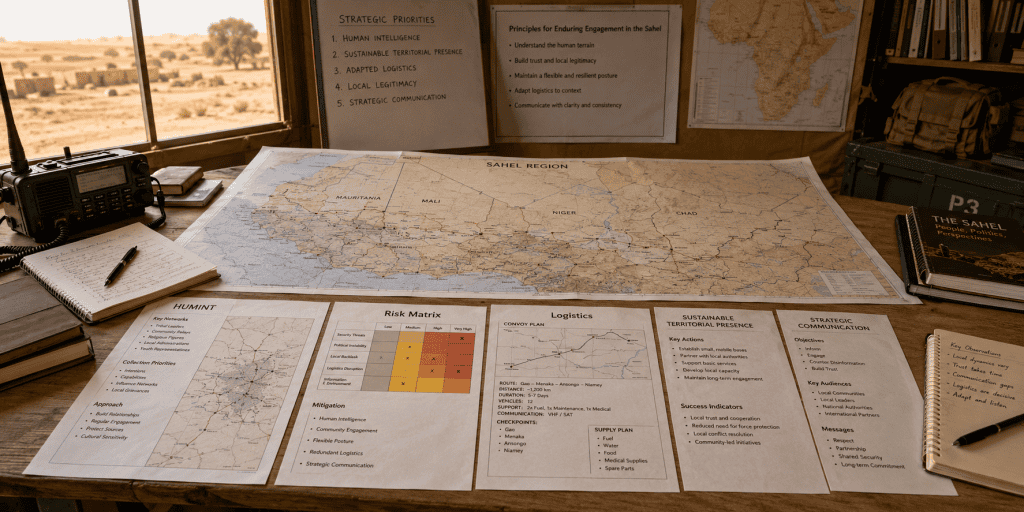
First, human intelligence must play a central role. Without reliable local networks, cultural knowledge, tribal understanding, analysis of illicit economies and a refined reading of community dynamics, any operation remains incomplete.
Second, territorial presence must be sustainable. Short-term operations are not enough. The population must perceive continuity, protection and the real capacity of the state or its allies.
Third, logistics must adapt to the environment. Forces that depend on heavy structures must develop more flexible, resilient models suited to the terrain.
Fourth, local legitimacy is as important as military capability. If the population perceives the state as distant, corrupt, abusive or incapable, armed groups will find space to exploit that gap.
Fifth, strategic communication must be treated as part of the conflict. The perception of security, control and permanence directly influences the behavior of communities, local forces, international allies and public opinion.
10. Conclusion
The jihadist war in the Sahel cannot be understood solely through technological superiority, force comparison or the elimination of targets. It is a conflict of resistance, adaptation and attrition, where terrain, time, population and perception are as important as weapons.
These organisations do not need to be stronger in conventional terms. It is enough for them to be persistent, flexible, difficult to fix and capable of exploiting the political, social and logistical weaknesses of their adversaries.
The strategic question is not only how to defeat them militarily, but how to prevent them from continuing to transform the fragility of the environment into an operational advantage.
In the Sahel, victory will not depend only on who has more technology, more vehicles or more firepower. It will depend on who understands the terrain better, who can sustain presence more effectively, who generates greater legitimacy and who can endure longer without losing sight of the final political objective.