
Tariq Ramadan: From Islamist Intellectual Figure to Criminal Conviction for Rape
WHO IS TARIQ RAMADAN AND WHAT IS HIS ROLE IN THE MUSLIM BROTHERHOOD?
A FAMILY BUSINESS.
A LITTLE HISTORY
The Muslim Brotherhood (al-Ikhwan al-Muslimun, MB) emerged in Egypt at the end of the 1920s in a sociopolitical context of great disorder in the region, marked by the traumas of colonial influence and by the abolition of the Caliphate by Kemal Atatürk in 1924, which had symbolized the unity of believers. To emerge from this existential crisis of decline in Muslim societies, some activists saw Islam as the only remedy.
It was within this framework that the MB reform project was shaped by an Egyptian schoolteacher, Hassan al-Banna (1906-1949). The movement also evolved as it internationalized through a series of adaptations to the national contexts of each country. The Muslim Brotherhood embodies one of the intellectual matrices of Islamism, understood as a religious and political ideology that attributes broad social claims to Islam in society as a whole.
Since the late 1990s, the reform project advocated by the Muslim Brotherhood, through which it seeks to dominate the cultural field, has been confronted with the emergence of a counter-hegemonic Salafist discourse from Saudi Arabia, which advocates an alternative vision of society and is engaged in a symbolic struggle over representation and the construction of reality.
Hani Ramadan
The establishment of the Muslim Brotherhood in the Gulf monarchies, and above all in Qatar, is strongly linked to the complex history of the movement’s relations with the Egyptian state, which have oscillated, depending on place and period, between clandestinity and legalism, repression and tolerance, integration and exclusion.
The Muslim Brotherhood movement is shaped by dynamics that create a perpetual tension between fragmentation and unification, since Islamists are at once members of a transnational network that monopolizes their loyalties and citizens of a state in which they hold positions.
MASS MOVEMENT: PREACHING AND ACTION.
Qatar, above all through Tariq Ramadan, has achieved a new advance in European Islam. It is true that Qatari sponsors already make regular donations to the Union of Islamic Organizations of France (UOIF, CCMTF, etc.) and to others in Germany or Belgium, heirs to and European sounding boards for the ideology of the Muslim Brotherhood. This ideology is precisely shared by a large part of the Muslim population in Europe, confirming the privileged relations that exist between the emirate and Sunni political Islam movements in Europe.
Two notable and closely related characteristics may objectively bring part of the Qatari ruling elite closer to Tariq Ramadan: personal financing (Tariq receives $35,000 a month from Qatar) for someone who appears to be one of the most prominent leaders and spokespersons of European Islam. This establishes a collaboration, the result of a marriage of convenience, with clearly understood mutual interests: maintaining a brand image in several European countries where a significant number of Muslims live, and cosmopolitanism, which, in a globalized world, widely benefits the most mobile and multi-positioned actors, whether individual or collective; that is, those well placed across a plurality of social fields (economic, political, cultural and religious) and across multiple national arenas.
STRATEGY AND MODES OF ACTION
The Muslim Brotherhood is pragmatic and patient. Its strategy is inspired by processes of cultural hegemony: to control a society as a whole, one must first subvert culture (civil society) in order to gain control of political society. They analyze societies’ weaknesses, look for internal contradictions and use them to advance their project: the victimization of Muslim communities, alleged lack of respect for human rights, ‘false tolerance toward Western societies,’ the de-Christianization of populations, and so on. Recourse to double discourse is almost permanent: victimization, denunciation of alleged Islamophobia, etc.
The Muslim Brotherhood’s strategy in Europe is long term. They rely more on cultural, social and demographic struggle than on armed jihad. They base themselves on education (Islamizing the grassroots), social actions (winning hearts), political and judicial activism (perpetuating their presence and making it indispensable), victimization through Islamophobia, and fundraising (EU, NGOs, etc.). These
modes of action are fully in line with the Brotherhood. The fulfillment of the caliphal prophecy. It is a strategic device whose sole objective is to set in motion, guide and supervise the ‘Islamic movement’ toward a global and universal Islamic society, which for him is the only possible future.
International, national and local spaces are more intertwined than ever in the context of advanced globalization. This cosmopolitanism is not only accepted by Tariq Ramadan, but constantly proposed by him: ‘I am Swiss by nationality, Egyptian by memory, Muslim by religion, European by culture, universalist by principle, Moroccan and Mauritian by adoption’ but above all ‘Muslim’ and a great hypocrite. By financing the center led by Tariq Ramadan, Qatar is working above all on its brand image among the new generations of European Muslims who are attached to religion and who are also seeking opportunities in the market of political Islam that they intend to impose.
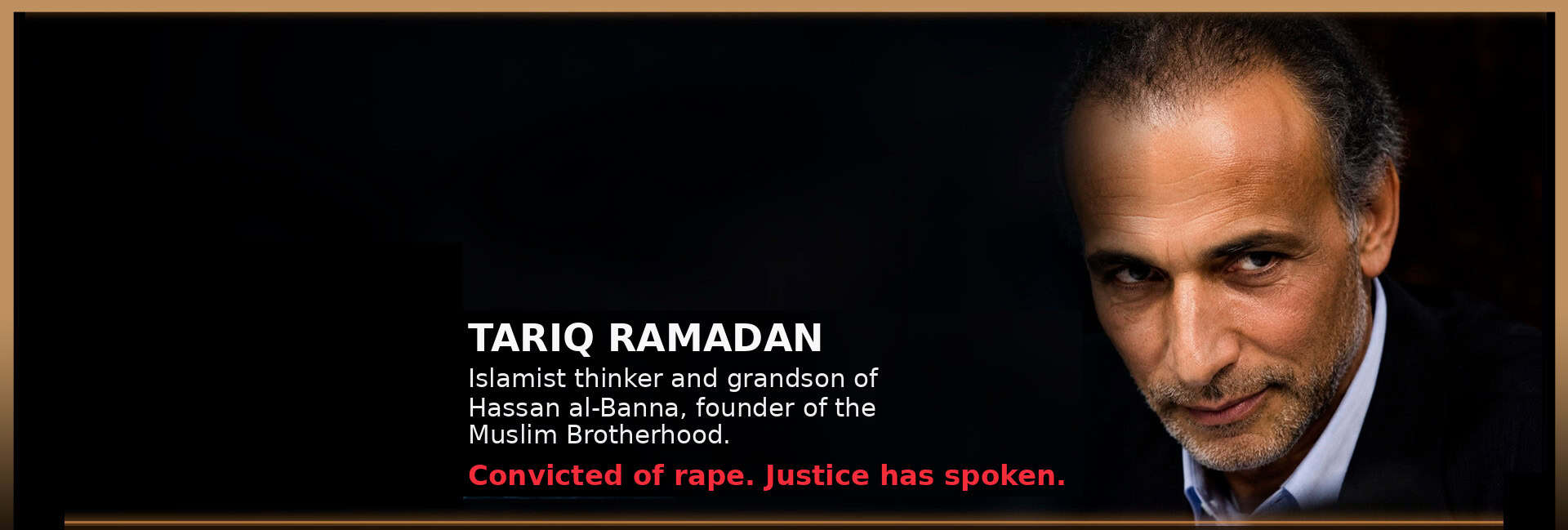
Tariq Ramadan is a dangerous man. He is a triple impostor. A moral impostor. For a quarter of a century, he advocated rigor and fidelity while at the same time leading a completely dissolute life. The things he said to women on a daily basis are nauseating.
Tariq is also an intellectual impostor. He misled his audience by presenting himself as a professor of philosophy and Islamic studies at the University of Fribourg, when he was only a volunteer lecturer. Tariq Ramadan calls himself a ‘scholar,’ although his knowledge, according to major Islamologists, is quite limited.
JUDICIAL UPDATE ON RAPE CONVICTIONS
Tariq Ramadan – update as of June 28, 2026
Legal caution note
This update distinguishes between final convictions, default convictions and proceedings that may be subject to further review. In the case of Tariq Ramadan, the information available up to June 2026 makes it possible to refer to a final conviction in Switzerland and to a criminal conviction in France handed down in absentia, with possible subsequent procedural effects if a new trial is triggered or admissible appeals are filed.
1. Switzerland: final conviction for rape and sexual coercion
On August 28, 2025, the Swiss Federal Supreme Court made public a press release on the judgment of July 22, 2025, by which it dismissed Tariq Ramadan’s appeal against the conviction handed down by the Geneva Court of Justice. The Swiss conviction was confirmed for rape and sexual coercion in relation to events that occurred on the night of October 28 to 29, 2008, in a Geneva hotel.
The confirmed sentence was three years’ imprisonment, of which one year was firm. The Federal Supreme Court stated that the Geneva court had based its decision on several testimonies, certificates, medical notes and private expert opinions which, according to the court, were consistent with the facts reported by the victim. It also recalled that Ramadan had been acquitted at first instance in 2023 before being convicted on appeal.
In practical terms, this decision made the Swiss conviction final within the Swiss judicial system. His lawyers announced their intention to apply to the European Court of Human Rights, but that international route does not change the fact that, in Switzerland, the conviction was confirmed by the highest federal judicial authority.
2. France: 18-year prison sentence for rapes of three women
On March 25, 2026, the Paris departmental criminal court sentenced Tariq Ramadan to 18 years’ criminal imprisonment for rapes committed against three women, including one count of rape of a vulnerable person. The proceedings were held behind closed doors and the conviction was delivered by default, as Ramadan did not appear before the court.
In addition to the prison sentence, French judicial media reported complementary measures: eight years of socio-judicial supervision, an obligation to undergo treatment, deprivation of civil and civic rights for ten years, and a definitive ban on entering French territory once the sentence has been served. The court also confirmed an arrest warrant issued during the proceedings.
This conviction must be presented precisely: it is an extremely serious French criminal conviction, but it was handed down in absentia. After the ruling, Ramadan announced his intention to obtain a new trial. According to French legal analyses, for him to benefit from a new trial within the framework of a default conviction, he would have to be arrested or surrender to the competent authorities.
3. Overall assessment: a substantial change in judicial profile
Tariq Ramadan’s judicial situation has changed substantially compared with earlier stages of the case. It is no longer only a matter of media accusations or open proceedings: there is a final conviction in Switzerland for rape and sexual coercion, and a French 18-year conviction for rapes of three women, handed down by default.
For an analytical or intelligence document, three levels should be separated:
• The ideological and political level: his role as an intellectual, preacher or figure linked to European Islamist networks should be analyzed with its own separate sources.
• The judicial level: convictions for sexual violence should be treated as judicial facts, citing date, court, sentence and procedural status.
• The reputational level: the convictions have seriously damaged his public standing and reduce his ability to act as a moral or intellectual reference point in European spaces.
Summary judicial chronology
• May 2023: Ramadan was acquitted at first instance by a Geneva court in the Swiss case.
• August/September 2024: the Geneva judiciary overturned the acquittal and convicted him of rape and sexual coercion, sentencing him to three years’ imprisonment, with one year firm.
• July 22, 2025: the Swiss Federal Supreme Court dismissed Ramadan’s appeal against the Geneva conviction.
• August 28, 2025: the Swiss Federal Supreme Court publicly confirmed the conviction; the conviction became final in Switzerland.
• March 2, 2026: the trial opened in Paris for rapes of three women; Ramadan did not appear.
• March 6, 2026: the French court decided to continue the trial in absentia and issued an arrest warrant.
• March 25, 2026: the Paris departmental criminal court convicted him by default and sentenced him to 18 years’ criminal imprisonment for rapes of three women.
• Late March 2026: Ramadan stated his intention to obtain a new trial.
Recommended wording to replace or add to the report
In light of the latest judicial decisions, Tariq Ramadan should be presented as a figure who is not only controversial from an ideological standpoint, but also criminally convicted of serious sexual offences. In Switzerland, his conviction for rape and sexual coercion was confirmed by the Federal Supreme Court in 2025. In France, he was convicted by default in March 2026 and sentenced to 18 years’ criminal imprisonment for rapes of three women. Because the latter ruling was delivered in absentia, it may give rise to subsequent procedural developments, but to date it constitutes the most serious French criminal ruling against Ramadan.
Sources consulted
• Swiss Federal Supreme Court, press release, ‘Verdict de la Cour de justice genevoise contre Tariq Ramadan confirmé’, judgment of July 22, 2025, published on August 28, 2025.
• Le Monde, ‘Tariq Ramadan définitivement condamné pour viol par la justice suisse’, August 28, 2025.
• Associated Press, ‘Switzerland’s top court upholds Islamic scholar Tariq Ramadan’s conviction for rape, sexual coercion’, August 28, 2025.
• Le Monde, ‘Tariq Ramadan condamné à dix-huit ans de prison pour les viols de trois femmes…’, March 26, 2026.
• Swissinfo, ‘Tariq Ramadan sentenced to 18 years’ imprisonment for rape’, March 26, 2026.
• RTS, ‘Tariq Ramadan condamné à 18 ans pour viols veut un nouveau procès’, March 26, 2026.
• Le Club des Juristes, ‘Tariq Ramadan va-t-il purger sa peine de 18 ans d’emprisonnement pour viol ?’, March 27, 2026.